BIUTIFUL, THE REPORTER AND POTATO OMELETTE

Today I want to talk to you about two movies and a recipe.
The recipe will be a potato omelet.
The films: Biutiful , by Alejandro González Iñárritu, released in 2010, and The Reporter ( Professione: reporter ), by Michelangelo Antonioni, from 1975.
Two very different films, separated by thirty-five years, but which ended up meeting for me in the same place: Barcelona.
And, in a way, also in a potato omelet.
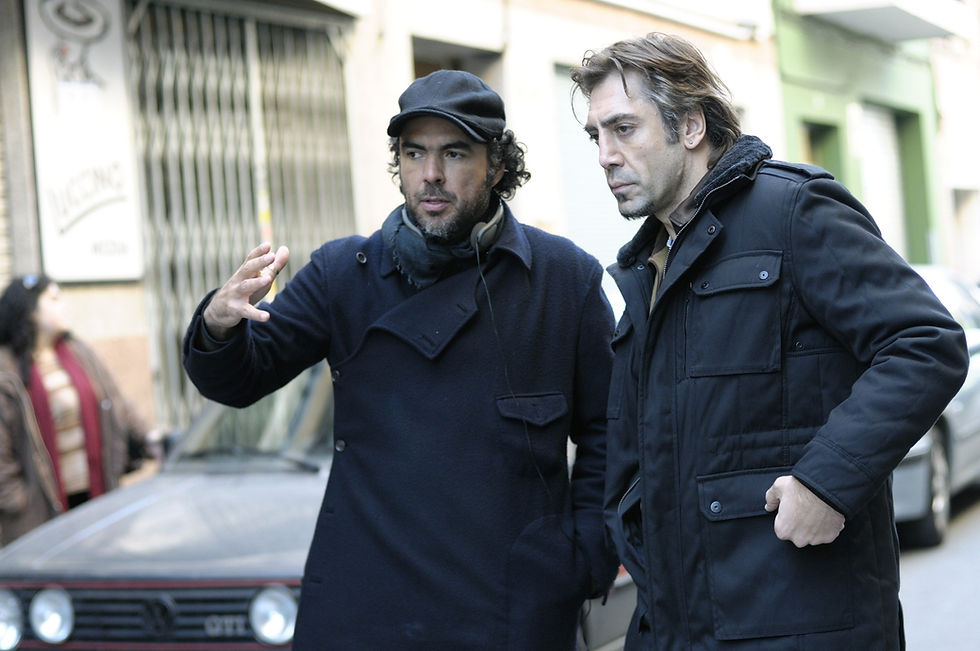
Biutiful tells the story of Uxbal, played by Javier Bardem, a man who lives in a Barcelona far removed from the city's tourist image. He is the father of two children, works in clandestine businesses, and survives in a world of immigration, precariousness, and petty crime. When he is diagnosed with terminal cancer, he begins to confront not only his own death but also the question of what will become of his children when he is gone. Uxbal also has a unique sensitivity to the dead: he can perceive their souls.
I saw Biutiful in the cinema when it premiered in Chile, with my mother. I remember it really affected me. I was quite young, and there were things in the film that I found hard to believe. I didn't know those things happened in the developed world. The precariousness, the exploitation, the undocumented immigration, that Barcelona hidden behind the city we know from postcards. I remember empathizing deeply with Uxbal. With his sensitivity, with his way of seeing the world, and with that strange mix of toughness and fragility.

Many years later, when I arrived in Barcelona at the end of 2018, I decided to live in the Raval neighborhood. I lived on Joaquín Costa street.
It seemed like a very central neighborhood to me, and I was drawn to its streets, its slightly dirty corners, its buildings, and that mix of things that made it quite unique. There was something about the Raval that attracted me. I liked walking around there, wandering through its streets, and feeling like I was truly living in Barcelona.
And one of those nights when I was watching movies —because, especially at that time, I could spend hours watching movies— Biutiful came on .
And suddenly I realized.
Those were the neighborhoods I used to frequent.
The places where he lived.
The streets I was walking through.
The Barcelona I was seeing in the film was, without my knowing it when I arrived, the same Barcelona in which I was living.
On the other hand, when I told my dad at fourteen that I wanted to be a film director, he decided to give me art films every week. That's how I discovered, among other things, Antonioni.
In Anchorman , Jack Nicholson plays David Locke, a journalist in Africa who, after discovering the body of a man named Robertson, decides to switch identities with him. What begins as an attempt to disappear and start over gradually transforms into something else entirely: a flight that fails to resolve what he's truly trying to escape. Because no matter how far you move, you're still with you.

Antonioni filmed on location in Barcelona, including Las Ramblas, Palau Güell, and La Pedrera. And many years later, those streets would also become part of my life.
Around 2020, I took editing classes with Joan Marimon. One of the assignments he gave us involved analyzing a film practically shot by shot: constructing a timeline, noting when diegetic and non-diegetic music appeared, identifying the scenes, the turning points, the three acts, the dramatic structure… It was very meticulous work, and I learned a great deal.
I decided to do it about The Reporter .

It was the height of the pandemic and Barcelona was practically empty. I went for walks along those same streets I had seen in the film.
Streets that Antonioni had filmed decades earlier, full of people from another era, full of movement and life, are now silent, empty and, at times, even a little gloomy.
Since I was doing the editing work, I had watched the film with almost obsessive attention. I was noticing the locations. What had changed? What remained the same? What was left of that Barcelona?
That same year we filmed a short film on analog with a Russian Krasnogorsk camera in those neighborhoods, and also a music video for a flamenco percussionist friend. I feel a small privilege to have left some record of those places.
Because who knows what they'll be like in thirty years.
Below my house there was a bar called El Parra .

If you're passing by, go in.
Really.
Go for a meal or a drink. I highly recommend it.
They had some really good potato omelets.
And the croquettes were spectacular too.
Biutiful, The Reporter and potato omelette with onion
Ingredients
5–6 small potatoes
1 medium onion
3 large eggs
Olive oil
Salt
Preparation
Slice the potatoes thinly, about 2–3 mm thick. Slice the onion into thin julienne strips.
Pour enough olive oil into a frying pan to cover the potatoes well, and heat it over medium heat. Add the potatoes, onion, and salt.
Cook for about 20–25 minutes, stirring occasionally. We don't want crispy potatoes. They should be very tender, almost falling apart, and the onion should be well softened and sweet.
Drain the potatoes and onion well. Reserve a little of the oil.
Beat the three eggs with a pinch of salt. Add the potatoes and onion and mix carefully. Let it rest for about five minutes.
Put a teaspoon of the reserved oil into a non-stick frying pan about 20 cm in diameter. Heat over medium heat.
Pour in the mixture and cook for 2–3 minutes, gently moving the pan to prevent sticking.
When the edges are set but the center is still somewhat liquid, place a plate on top and flip it over quickly.
Return the tortilla to the pan and cook for another 1–2 minutes if you want it juicy, or 3–4 minutes if you prefer it more set.
Let it rest for a couple of minutes before cutting it.
And, above all, medium-low heat.
The tortilla doesn't need adrenaline.
BIUTIFUL, THE REPORTER AND POTATO OMELETTE


Comments